
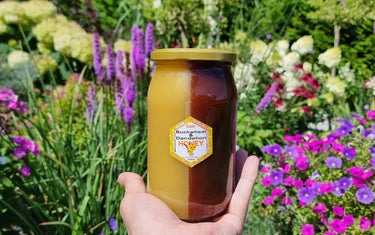
Many customers ask us: "My honey has gone solid – is it still good?" The answer: yes, absolutely. Crystallisation is a completely natural process and even a sign that the honey is unprocessed.
Why does honey crystallise?
Honey consists mainly of glucose and fructose. Over time, glucose forms fine crystals – the honey becomes creamy or firm. How quickly this happens depends on the ratio of the two sugars:
- Fast (a few days to weeks): rapeseed honey, dandelion honey, sunflower honey
- Medium (a few months): linden honey, buckwheat honey, raspberry honey
- Slow (often stays runny for over a year): acacia honey, honeydew honey
Storing it properly
- Temperature: Best at room temperature, ideally 15–20 °C. In the fridge honey crystallises faster.
- Light: Keep it in the dark, for example in a kitchen cupboard.
- Close tightly: Honey absorbs moisture and smells from its surroundings.
- Clean spoon: Keep crumbs and butter out of the jar.
Stored correctly, honey keeps for a very long time – you will find the best-before date on the label.
Making crystallised honey runny again
- Fill a pan with warm water – no more than 40 °C (hand-warm).
- Place the open jar in it so that the water reaches roughly the level of the honey.
- Stir now and then and be patient – depending on the amount it takes from 30 minutes to a few hours. Rewarm the water if needed.
Please don't: use the microwave or boiling water – strong heat changes the taste and aroma of the honey.
Or simply enjoy it firm
Crystallised honey spreads beautifully on bread and doesn't drip. Many of our customers actually prefer it that way. In tea or warm (not hot) drinks it dissolves anyway.
White streaks on the glass?
Sometimes light patterns or "frosting" appear on the inside of the jar. These are tiny air pockets between the honey and the glass that form during crystallisation – not mould and not a quality defect.